
Artwork
that Speaks to
YOU
for
YOUR
HOME
for
YOUR
beautiful space
Graphics
sculpture
-
Installation, Mixed Media, Shihab, Watercolour
Extended panorama of human life (detail) | 2005 | Watercolour on paper | 133 x 5000 cm (1,33 x 50 m)-part3
 Installation, Mixed Media, Shihab, Watercolour
Extended panorama of human life (detail) | 2005 | Watercolour on paper | 133 x 5000 cm (1,33 x 50 m)-part3
Extended panorama of human life (detail) | 2005 | Watercolour on paper | 133 x 5000 cm (1,33 x 50 m)-part3
Collection in GermanySKU: ephl-2005-W-133c5000-3


-
Art History, Digital Drawing, Exhibition, Research, Shihab
Ed-Dur, UAE | 2024 | Presentation | Techniquest, Cardiff | UK
 Art History, Digital Drawing, Exhibition, Research, Shihab
Ed-Dur, UAE | 2024 | Presentation | Techniquest, Cardiff | UK
Prof. Ernie Haerinck reveals evidence of the sun god temple at Ed-Dur, dating back to 100 CE, housing an eagle statue and Roman bronze sculptures. Ed-Dur blended Mesopotamian and Hellenistic influences to shape their deities. Another noteworthy site within the UAE is the monastery of Nestorian Christians, constructed on Sir Bani Yas Island in Abu Dhabi after the 6th century.
SKU: Ed-Dur -
Art History, Digital Drawing, Drawing, Exhibition, Research, Shihab
John Ruskin 1885, Stones of Venice | 2024 | Presentation | Techniquest, Cardiff | UK
 Art History, Digital Drawing, Drawing, Exhibition, Research, Shihab
John Ruskin 1885, Stones of Venice | 2024 | Presentation | Techniquest, Cardiff | UK
Vermeer’s “Girl with a Pearl Earring” created around 1665 CE, has been interpreted as portraying a young woman in an attire with exotic influences, potentially inspired by Ottoman court fashion. The blue turban and lemon-yellow veil-like cloth cascade from the top to the shoulders, presenting an exotic Ottoman attire from the Dutch perspective. Particularly captivating element of the painting is the substantial waterdrop-shaped pearl hanging from her ear. The segment of the pearl glistens with a golden hue, creating a vivid contrast against the shaded area of her neck. During that era, Oman and Ras Al Khaima in UAE were prominent pearl producers in the Middle East, catering to Europe’s demand for these exquisite gems.
SKU: John Ruskin 1885, Stones of Venice


-
Art History, Digital Drawing, Drawing, Exhibition, Research, Shihab
Shared responsibility of humankind beyond borders | 2023 | digital drawings | 2452 x 1440 px
 Art History, Digital Drawing, Drawing, Exhibition, Research, Shihab
Shared responsibility of humankind beyond borders | 2023 | digital drawings | 2452 x 1440 px
I collect visual examples and data from various locations and merge them to create a new art form. This artistic practice remaps geographical locations of cultural fusion based on the data collected from different aspects and places. It traces the historical movements of artifacts, transformations, and similarities across various destinations, with the intention of remapping the modern global cultural development and highlighting the importance of preserving them as a shared responsibility of humankind beyond borders. The collection of artifacts from around the world narrates the shared stories of human cultural development. It emphasizes the long history of human creativity and adaptation through diverse tales of encounters and the evolution of culture.
SKU: ln-2003-iop-30x21-1-1 -
Art History, Digital Drawing, Exhibition, Research, Shihab
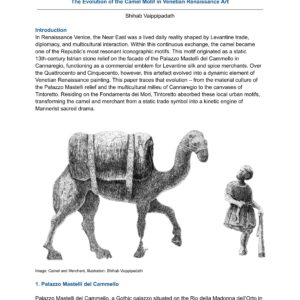
Resonance of the Caravans: The Evolution of the Camel Motif in Venetian Renaissance Art | 2026
 Art History, Digital Drawing, Exhibition, Research, Shihab
Resonance of the Caravans: The Evolution of the Camel Motif in Venetian Renaissance Art | 2026
Resonance of the Caravans:
The Evolution of the Camel Motif in Venetian Renaissance ArtIntroduction
In Renaissance Venice, the Near East was a lived daily reality shaped by Levantine trade, diplomacy, and multicultural interaction. Within this continuous exchange, the camel became one of the Republic’s most resonant iconographic motifs. This motif originated as a static 13th-century Istrian stone relief on the facade of the Palazzo Mastelli del Cammello in Cannaregio, functioning as a commercial emblem for Levantine silk and spice merchants. Over the Quattrocento and Cinquecento, however, this artefact evolved into a dynamic element of Venetian Renaissance painting. This paper traces that evolution – from the material culture of the Palazzo Mastelli relief and the multicultural milieu of Cannaregio to the canvases of Tintoretto. Residing on the Fondamenta dei Mori, Tintoretto absorbed these local urban motifs, transforming the camel and merchant from a static trade symbol into a kinetic engine of Mannerist sacred drama.SKU: Ed-Dur-1 -
Art History, Digital Drawing, Exhibition, Research, Shihab
Ed-Dur, UAE | 2024 | Presentation | Techniquest, Cardiff | UK
Art History, Digital Drawing, Exhibition, Research, ShihabEd-Dur, UAE | 2024 | Presentation | Techniquest, Cardiff | UK
Prof. Ernie Haerinck reveals evidence of the sun god temple at Ed-Dur, dating back to 100 CE, housing an eagle statue and Roman bronze sculptures. Ed-Dur blended Mesopotamian and Hellenistic influences to shape their deities. Another noteworthy site within the UAE is the monastery of Nestorian Christians, constructed on Sir Bani Yas Island in Abu Dhabi after the 6th century.
SKU: Ed-Dur -
Art History, Digital Drawing, Pen Drawing, Research, Shihab
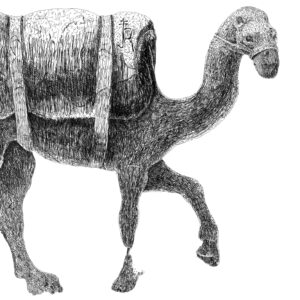
Resonance of the Caravans | 2026 | digital drawing | 4k
 Art History, Digital Drawing, Pen Drawing, Research, Shihab
Resonance of the Caravans | 2026 | digital drawing | 4k
Resonance of the Caravans:
The Evolution of the Camel Motif in Venetian Renaissance ArtIntroduction
In Renaissance Venice, the Near East was a lived daily reality shaped by Levantine trade, diplomacy, and multicultural interaction. Within this continuous exchange, the camel became one of the Republic’s most resonant iconographic motifs. This motif originated as a static 13th-century Istrian stone relief on the facade of the Palazzo Mastelli del Cammello in Cannaregio, functioning as a commercial emblem for Levantine silk and spice merchants. Over the Quattrocento and Cinquecento, however, this artefact evolved into a dynamic element of Venetian Renaissance painting. This paper traces that evolution – from the material culture of the Palazzo Mastelli relief and the multicultural milieu of Cannaregio to the canvases of Tintoretto. Residing on the Fondamenta dei Mori, Tintoretto absorbed these local urban motifs, transforming the camel and merchant from a static trade symbol into a kinetic engine of Mannerist sacred drama.SKU: Resonance of the Caravans
-
Landscape, Pen Drawing, Shihab
Llandaff cathedral II, Cardiff, UK | 2022 | pen drawing on paper | 15 x 15 cm
 Landscape, Pen Drawing, Shihab
Llandaff cathedral II, Cardiff, UK | 2022 | pen drawing on paper | 15 x 15 cm
Llandaff cathedral II, Cardiff, UK | 2022 | pen drawing on paper | 15 x 15 cm
Llandaff Cathedral (1120 AD)
Llandaff Cathedral is a famous medieval-Gothic church in Cardiff, built in 1120 AD. During my time living in Germany between 1998 and 2012, I had the opportunity to interact with several people who had participated in World War II. An adventurous experience shared with me by a former pilot I met in Heidelberg might be connected to this cathedral.
In 1941, during World War II, when he was just 19 years old, he flew a bomber aircraft from Frankfurt toward Britain and dropped bombs there. However, the sight that awaited him when he returned home after the mission was devastating; the American army had completely bombed and destroyed his village. He later told me that he had gained absolutely nothing from the war.
The cathedral suffered severe damage from bombings during World War II. A large crater caused by a fallen bomb back then can still be seen on the grounds outside the cathedral today. Even there, they haven’t explicitly mentioned ‘Germany’; instead, they have only written ‘our enemies.’ This stands as a symbol of respect and humanity shown toward the German people. I spent a few minutes in silence, praying for both the German and Welsh people who lost their lives during the war.
The cathedral was later restored, and it still stands today as a proud symbol of the culture and grandeur of Wales.
hashtagllandaffcathedral hashtagwales hashtagdrawing hashtagshihabvaippipadath
SKU: Llandaff cathedral-2


Showing 1–36 of 188 results


